New concrete rarely looks perfect in its first month. Some of what worries people is normal and fades. Some is a real defect that the contractor should deal with. Here is how to tell them apart in a hot, wet climate.
Why is my new concrete already cracking?
New concrete can crack in the first days because it shrinks as it dries, and summer heat here makes it dry fast. Thin hairlines that stay flat are common and are mostly a matter of looks. Joints are cut so that the shrinkage crack forms inside them, out of sight. A crack that is wide, runs right across the slab away from the joints, or has one side higher is not normal and points to the base or the joint layout.
Is the contractor responsible for a crack that shows up weeks later?
The contractor is responsible when the crack comes from workmanship: joints too far apart or cut too late, a soft base, a slab thinner than agreed, or no curing in hot weather. Hairline shrinkage cracks are usually excluded in contracts, because no one can prevent all of them. Read what your contract says, take dated photos next to a tape measure, and ask in writing for a visit.
Why does my new concrete have dark and light patches?
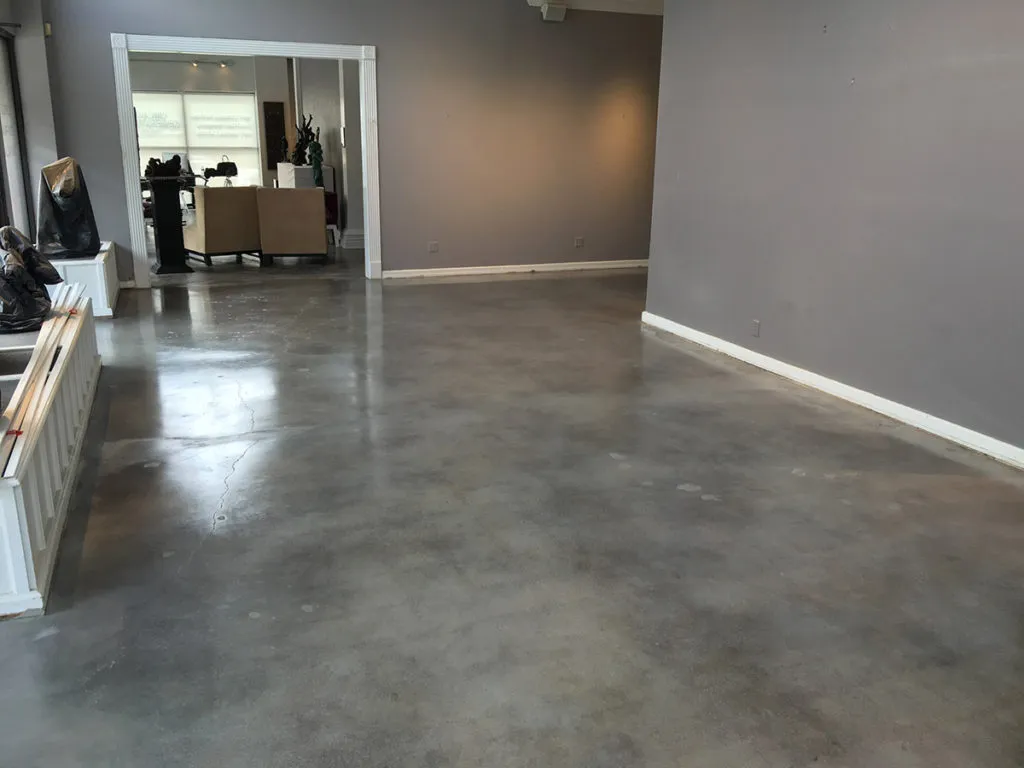
Dark and light patches in the first weeks are nearly always uneven drying. Shaded and damp areas stay dark longer, and in New Orleans humidity that can go on for a month or more. Different truckloads, a rain shower during finishing, or plastic sheeting left touching the surface can also leave marks. Most of it evens out. Give it 30 days and a few dry spells before you judge the color.
What happens if it rains on fresh concrete?
If it rains on fresh concrete in the first few hours, the water can wash cement off the top and leave a weak, sandy, pitted surface. That matters a lot here, where afternoon storms build quickly from late spring through early fall. Once the slab has been finished and has stiffened, rain does little harm and even helps it cure. A crew should watch the radar and have plastic on site. A surface that was damaged by rain may need grinding and an overlay.
There are footprints, rough spots and a wavy finish with low spots. Is that acceptable?
No. Footprints, tool marks, rough patches and low spots that hold water are finishing defects. A broom finish should look even and a slab should drain. Small birdbaths can sometimes be ground or filled. A slab that ponds over a wide area was set at the wrong grade. Point it out before you make the last payment.
Are control joints really necessary? The contractor says he will saw-cut the joints a week later. Is that all right?
Yes, control joints are necessary. Concrete shrinks, and a joint is a planned weak line that tells the crack where to go. On a 4-inch slab they are usually spaced 8 to 12 feet apart and cut about a quarter of the slab depth. On ground that moves as much as ours, joints also let panels shift a little without breaking each other.
No, a week is far too late. Saw cuts belong in the slab as soon as it can take the saw without ragged edges, which is normally the same day or the next morning, and sooner in hot weather. After a week the slab has already picked its own crack lines. Ask for the joints to be tooled in during finishing or sawn within about a day.
The slab was poured without rebar or mesh and I only found out afterward. What now?
First check what the contract said. If steel was written in and the slab was poured without rebar or mesh, the contractor did not deliver the job you paid for, and you can ask for a price reduction or a redo. If steel was never specified, you have less to stand on. Steel does not prevent cracks, but it holds the pieces tight and level, and that matters a great deal on settling soil. Keep your photos of the pour.
What can I do if the contractor will not come back to fix it?
Put the problem in writing with photos and a date by which you expect an answer. If the contractor still will not come back, send a formal letter by certified mail. Next, look the company up with the Louisiana State Licensing Board for Contractors, which accepts complaints about contractors it registers or licenses. The Consumer Protection Section of the Louisiana Attorney General also takes complaints. Small claims court is the last step. Do not pay the remaining balance while a real defect is open.
My new stamped concrete is slippery when wet. Can that be fixed? Why is my stamped concrete cloudy, fading or peeling?
Yes. Stamped concrete turns slippery when a glossy sealer goes on without any grit, and in our humidity a film of mildew makes it worse. The fix is to recoat with a sealer that has a fine non-slip additive mixed in, or to strip the gloss and use a matte sealer. Around pools and on steps, grit should have been in the first coat.
A cloudy white haze means moisture is trapped under the sealer. That is very common in New Orleans, because the slab is seldom fully dry and the ground under it is wet. Sealer applied too thick, or on a humid day, blushes white and later peels. Fading comes from strong sun on the color coat. The cure is usually to strip or re-melt the sealer with solvent and put on a thin coat of a breathable product.
The surface started flaking in the first year. Why? It was poured in extreme heat and now it looks bad. Was that a mistake?
Flaking in the first year points to a weak top layer. With almost no freezing here, the cause is usually water worked into the surface during finishing, a rain shower on the fresh slab, or a hot windy day with no curing. The concrete below is often sound. Ask the contractor to inspect it. The normal repair is to grind off the weak layer and resurface.
Concrete poured in extreme heat needs extra care, and the result tells you whether it got that care. Signs of a rushed hot pour are fine surface cracks that appeared the same day, a dusty top, and color that varies from one end to the other. In a New Orleans summer a crew should start at dawn, dampen the base, pour fast, and begin curing straight away. If none of that happened, raise it with the contractor.
The stamped pattern is crooked and uneven. Should I make the final payment?
Hold back a fair share of the final payment until it is settled, and say why in writing. A stamped pattern that wanders off line, has seams that do not meet, or is deep in one place and faint in another is a workmanship problem. Pay for what was done properly. Some stamping faults can be touched up with a grinder and color. A badly misaligned pattern cannot be corrected without a new pour.
The crew left ruts in the lawn, washout and splatter. Who cleans it up?
The contractor does. Ruts from trucks and buggies, concrete washout dumped in the yard or the gutter, and splatter on walls, fences and cars are the crew's to put right. Washout should never go into a street drain, since those drains feed the city's pumps. Note the damage before final payment, and settle next time, before the job, where the truck will rinse out.
My new pad is out of level. Is that a defect?
A little slope is on purpose. Outdoor slabs should fall about one-eighth to one-quarter inch per foot so that rain runs off. A pad is out of level in the bad sense when it slopes the wrong way, holds water, or was meant to be flat for a shed, a hot tub or equipment and is not. Check with a long level and compare against what the quote said.
The forms were left on and now they are stuck. What should happen?
Forms normally come off a day or two after the pour. If they are left for weeks they can be hard to pull, and here the wet wood draws termites. The contractor should come back and take them out, then backfill along the slab edge so water cannot get under it. Removing the forms is part of the job, not an extra.
The real number for your address comes from a free visit and a written quote. Call (504) 732-1542, or text a photo of the area and we will tell you what we see.